



Central Bankers at the End of Their Rope?: Monetary Policy and the Coming Depression
By: Rasmus Jack
ISBN: 9780986085390

Central banks are becoming a force of economic destabilization in the 21st century–contrary to accepted notions of contemporary economic theory. The basic functions of central banks–whether managing money supply, supervising private banks, bailing out failing banks, stabilizing prices, promoting real investment, employment and growth–have all entered a state of increasing decay, breakdown and failure.
- Central banks globally have been losing control, individually and collectively, of the global money supply;
- have progressively destabilized the global economy with decades of ever-rising liquidity and debt;
- have chronically failed to prevent financial asset inflation bubbles or stop the steady drift toward deflation in goods, money and labor prices;
- have been unable to adapt to technology forces that have fundamentally restructured the global financial system;
- have effectively ignored the growth of capital markets, inside credit and shadow banking;
- have failed to regulate and supervise private banks that remain, post-2008, still addicted to high risk taking;
- have proven unable to develop policies and tools to effectively stimulate investment, jobs, and real GDP; and
- and have failed to construct a stable system to replace the gold standard or the Bretton Woods international monetary systems;
The book describes the fundamental causes of the breakdown and emerging crisis of central banks–with primary focus on the US Federal Reserve, the Banks of England and Japan, the Eurozone's ECB, and the People's Bank of China. The book's central theme is that central banks, as constituted today, are not only failing their basic functions–in the process becoming more desperate in experimenting with new measures and policies–but have become increasingly the vehicles of the interests of private bankers and investors. Central banks must therefore be democratized to represent the entire economy and not just bankers and investors. Proposals for institutional restructuring of the US Federal Reserve (and other central banks) are offered as means to ensure central bank independence of both banker-investor interests as well as politicians'. Public banking is discussed and argued as necessary, but not sufficient, as a solution. A Constitutional Amendment to democratize the Fed is proposed.
- Central banks globally have been losing control, individually and collectively, of the global money supply;
- have progressively destabilized the global economy with decades of ever-rising liquidity and debt;
- have chronically failed to prevent financial asset inflation bubbles or stop the steady drift toward deflation in goods, money and labor prices;
- have been unable to adapt to technology forces that have fundamentally restructured the global financial system;
- have effectively ignored the growth of capital markets, inside credit and shadow banking;
- have failed to regulate and supervise private banks that remain, post-2008, still addicted to high risk taking;
- have proven unable to develop policies and tools to effectively stimulate investment, jobs, and real GDP; and
- and have failed to construct a stable system to replace the gold standard or the Bretton Woods international monetary systems;
The book describes the fundamental causes of the breakdown and emerging crisis of central banks–with primary focus on the US Federal Reserve, the Banks of England and Japan, the Eurozone's ECB, and the People's Bank of China. The book's central theme is that central banks, as constituted today, are not only failing their basic functions–in the process becoming more desperate in experimenting with new measures and policies–but have become increasingly the vehicles of the interests of private bankers and investors. Central banks must therefore be democratized to represent the entire economy and not just bankers and investors. Proposals for institutional restructuring of the US Federal Reserve (and other central banks) are offered as means to ensure central bank independence of both banker-investor interests as well as politicians'. Public banking is discussed and argued as necessary, but not sufficient, as a solution. A Constitutional Amendment to democratize the Fed is proposed.
Related Products
ANCIENT EGYPTIAN ECONOMICS Kemetic Wisdom of Saving and Investing in Wealth of Body, Mind, and Soul for Building True Civilization, Prosperity and Spi
Publisher : Cruzian Mystic Books (January 19, 2011)
Language : English
Paperback : 184 pages
ISBN-10 : 1884564135
ISBN-13 : 978-1884564130
Item Weight : 7.8 ounces
$24.95
$18.95

The Black Tax: The Cost of Being Black in America
Publisher : Shawn D Rochester; 1st edition
January 15, 2018
Language : English
Paperback : 144 pages
ISBN-10 : 0999007203
$19.95
$12.00

Scaling People: Tactics for Management and Company Building
Publisher : Stripe Press
March 7, 2023
Hardcover : 480 pages
ISBN-10 : 1953953212
ISBN-13 : 9781953953216
$35.00
$18.95

Our Black Year: One Family's Quest to Buy Black in America's Racially Divided Economy
Maggie and John Anderson were successful African American professionals raising two daughters in a tony suburb of Chicago. But they felt uneasy over their good fortune. Most African Americans live in economically starved neighborhoods. Black wealth is about one tenth...
$20.00
$15.00
#1 Bestseller: How You Can Become A Bestselling Author In Only 30 Minutes A Day (PAPERBACK)
Discover Robert G. Allen's proven 12-step system to write, publish, and profit from your book in just 30 minutes a day. Build authority, boost income, and launch your book to #1 bestseller status-no prior audience required.
$20.00
$15.00
#1 Bestseller: How You Can Become A Bestselling Author In Only 30 Minutes A Day (HARDCOVER)
Discover Robert G. Allen's proven 12-step system to write, publish, and profit from your book in just 30 minutes a day. Build authority, boost income, and launch your book to #1 bestseller status-no prior audience required.
$35.00
$27.00
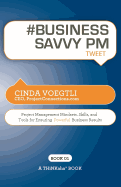
# BUSINESS SAVVY PM tweet Book01: Project Management Mindsets, Skills, and Tools for Ensuring Powerful Business Results
Business savvy does not mean a bagful of academic credentials, nor does it necessarily equate to a good deal of experience. Voegtli explains that a business savvy project leader is one who becomes an advocate for the project from the...
$24.95
$19.95