



A powerful examination of the unsettling history of photography and its fraught relationship to global antiblackness.
Since photography’s invention, black life has been presented as fraught, short, agonizingly filled with violence, and indifferent to intervention: living death—mortevivum—in a series of still frames that refuse a complex humanity. In Mortevivum, Kimberly Juanita Brown shows us how the visual logic of documentary photography and the cultural legacy of empire have come together to produce the understanding that blackness and suffering—and death—are inextricable. Brown traces this idea from the earliest images of the enslaved to the latest newspaper photographs of black bodies, from the United States and South Africa to Haiti and Rwanda, documenting the enduring, pernicious connection between photography and a global history of antiblackness.
Photography's history, inextricably linked to colonialism and white supremacy, is a catalog of othering, surveillance, and the violence of objectification. In the genocide in Rwanda, for instance, photographs after the fact tell viewers that blackness comes with a corresponding violence that no human intervention can abate. In Haiti, the first black republic in the Western Hemisphere, photographic “evidence” of its sovereign failure suggests that the formerly enslaved cannot overthrow their masters and survive to tell the tale. And in South Africa and the United States, a loop of racial violence reminds black subjects of their lower-class status mandated via the state. Illustrating the global nature of antiblackness that pervades photographic archives of the present and the past, Mortevivum reveals how we live in a repetition of imagery signaling who lives and who dies on a gelatin silver print—on a page in a book, on the cover of newspaper, and in the memory of millions.
The URL for this publication is https://on-seeing-mortevivum.org/.
Since photography’s invention, black life has been presented as fraught, short, agonizingly filled with violence, and indifferent to intervention: living death—mortevivum—in a series of still frames that refuse a complex humanity. In Mortevivum, Kimberly Juanita Brown shows us how the visual logic of documentary photography and the cultural legacy of empire have come together to produce the understanding that blackness and suffering—and death—are inextricable. Brown traces this idea from the earliest images of the enslaved to the latest newspaper photographs of black bodies, from the United States and South Africa to Haiti and Rwanda, documenting the enduring, pernicious connection between photography and a global history of antiblackness.
Photography's history, inextricably linked to colonialism and white supremacy, is a catalog of othering, surveillance, and the violence of objectification. In the genocide in Rwanda, for instance, photographs after the fact tell viewers that blackness comes with a corresponding violence that no human intervention can abate. In Haiti, the first black republic in the Western Hemisphere, photographic “evidence” of its sovereign failure suggests that the formerly enslaved cannot overthrow their masters and survive to tell the tale. And in South Africa and the United States, a loop of racial violence reminds black subjects of their lower-class status mandated via the state. Illustrating the global nature of antiblackness that pervades photographic archives of the present and the past, Mortevivum reveals how we live in a repetition of imagery signaling who lives and who dies on a gelatin silver print—on a page in a book, on the cover of newspaper, and in the memory of millions.
The URL for this publication is https://on-seeing-mortevivum.org/.
Related Products
KWAME BRATHWAITE: BLACK IS BEAUTIFUL
In the late 1950s and throughout the 1960s, Kwame Brathwaite used his photography to popularize the political slogan “Black Is Beautiful.” This monograph―the first ever dedicated to Brathwaite’s remarkable career―tells the story of a key, but under-recognized, figure of the...
$50.00
$42.00

GORDON PARKS: HOW THE PHOTOGRAPHER CAPTURED BLACK AND WHITE AMERICA
His white teacher tells her all-black class, You'll all wind up porters and waiters. What did she know? Gordon Parks is most famous for being the first black director in Hollywood. But before he made movies and wrote books, he...
$20.00
$16.00
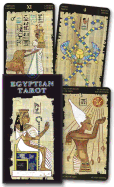
Egyptian Tarot Deck (Lo Scarabeo Decks)
Amazingly detailed and gracefully beautiful, Alasia''s tempera-on-papyrus paintings meld the stunning style of ancient Egyptian art with the mysteries of the Tarot. To shape the interpretations, Alasia relied on the conceptions of Jean-Baptiste Pitois, who linked the Tarot tradition to...
$25.00
Ethiopia: A Photographic Tribute to East Africa's Diverse Cultures & Traditions (Art Photography, Books about Africa)
Publisher : Earth Aware Editions (Dec 20 2022)Language : EnglishHardcover : 368 pagesISBN-10 : 1647227356ISBN-13 : 978-1647227357
$95.00
Philadelphia on Stone : Commercial Lithography in Philadelphia, 1828–1878
Philadelphia on Stone is the first work in over fifty years to examine the history of nineteenth-century commercial lithography in Philadelphia. The capstone to the Library Company of Philadelphia’s multifaceted Philadelphia on Stone project, this heavily illustrated volume of thematic...
$51.95
$36.95
Pharaoh : King of Ancient Egypt
A fresh look at the British Museum’s celebrated and extensive ancient Egyptian collection from across three thousand yearsPharaoh: King of Ancient Egypt introduces readers to three thousand years of Egypt’s ancient history by unveiling its famous rulers—the pharaohs—using some of the finest...
$60.00
$42.95
Golden Prospects : Daguerreotypes of the California Gold Rush
Exhibition Schedule: The Nelson-Atkins Museum of Art, Kansas City(September 6, 2019–January 26, 2020)Peabody Essex Museum, Salem(April 4, 2020–July 12, 2020)Yale University Art Gallery(August 28–November 29, 2020)A fresh, comprehensive, and critical look at the California gold rush through the lens of...
$60.00
$42.95